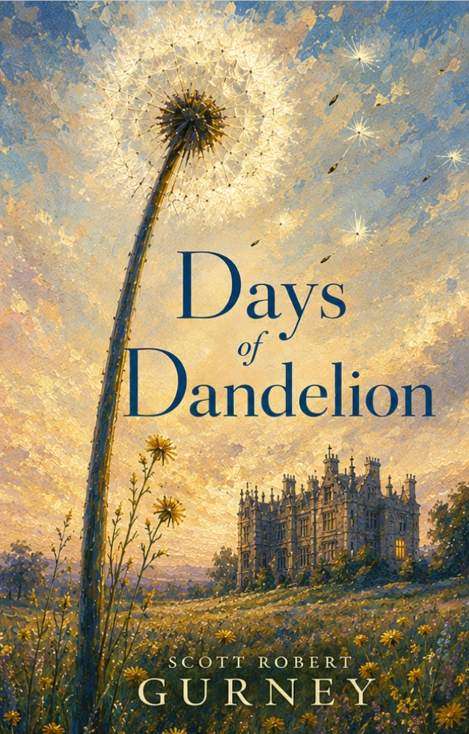
Why Write Days of Dandelion?
People often ask where an idea begins.
Was it a place? A conversation? A memory? A single sentence written in the margin of a notebook?
The truth is that Days of Dandelion did not begin with a plot. It began with a feeling.
For as long as I can remember, I have been fascinated by the quiet relationship between people and the places they leave behind. Old houses, forgotten gardens and weathered buildings have always seemed to me to possess a memory of their own. They become silent witnesses to lives once lived, holding traces of joy, grief, laughter and love long after voices have disappeared.
I have often wondered whether we inherit more than names and possessions. Perhaps we inherit ways of seeing the world. Perhaps we carry fragments of those who came before us without ever realising it.
Those thoughts slowly became the foundations of Days of Dandelion.
The novel is, in many ways, a conversation about memory. Not memory as nostalgia, but memory as something living—something that continues to shape our choices, our relationships and our understanding of ourselves. I wanted to write about the invisible threads that bind generations together, and about the places where those threads are most keenly felt.
Art became another essential part of that conversation.
I have always believed that great works of art ask something of us. They invite us to pause, to observe more closely and, perhaps, to understand ourselves a little better. In Days of Dandelion, painting is not simply a profession or a pastime. It is a language through which the characters search for meaning when words alone are no longer enough.
The dandelion itself arrived almost quietly.
It is a flower that many overlook, dismissing it as ordinary or transient. Yet there is something extraordinary about its resilience. It flourishes in unlikely places, returns year after year, and when its seeds are carried away by the wind, they become a promise that something will continue elsewhere. That seemed to me an image of hope, memory and continuity—themes that gradually came to define the novel.
People have also asked why I chose Catherine to tell this story.
The answer is simply that the story belonged to her. I did not begin by deciding to write from the perspective of a woman. I began by listening to the character whose voice emerged most clearly. Catherine's curiosity, her artistic devotion and her determination to understand the lives woven into the places around her became the lens through which the novel could best be told.
Writing Days of Dandelion has been a journey measured not only in years, but in countless revisions. Every page has been reconsidered, every sentence questioned, every chapter revisited in the hope of bringing the work a little closer to what it wanted to become. Along the way I discovered that writing is less about having answers than it is about learning to ask better questions.
If there is one hope I have for readers, it is not that they will simply remember the story. It is that, having closed the final page, they might look a little differently at the places that have shaped their own lives. That they might think of the conversations that continue long after people have gone, and of the beauty that often exists quietly, waiting only to be noticed.
For me, Days of Dandelion has always been an invitation to slow down.
To remember.
To look again.
And to discover that even the smallest things—a house, a painting, or a single dandelion carried on the wind—can hold an entire world.
—
Scott Robert Gurney
There is a curious relationship between art and storytelling.
At first glance they appear to be different languages. One speaks through paint, light and colour; the other through words arranged upon a page. Yet I have often wondered whether they are, in truth, attempting to answer the very same questions.
Both ask us to pause.
Both ask us to observe.
And both invite us to see the familiar with new eyes.
Perhaps that is why so many stories return to artists, musicians and writers. They are not simply professions; they are ways of looking. The artist notices what others pass by. The novelist attempts to give those observations a voice.
When I visit a gallery, I rarely find myself asking whether a painting is beautiful. Instead, I find myself wondering why it exists at all. Why this landscape? Why this face? Why this moment rather than another? Every painting is, in its own quiet way, a narrative. It captures not only what was seen, but how it was seen.
The same is true of literature.
A novel is never merely a sequence of events. It is a way of teaching us how to look. The most memorable stories alter our perception of the ordinary. They encourage us to notice details we may otherwise have overlooked: the changing light across an old room, the silence between two people who know one another well, the way a familiar place seems transformed by memory.
For me, art has always represented an act of attention.
In a world increasingly defined by speed, distraction and constant movement, both painting and literature ask something quietly radical of us. They ask us to remain still for a little longer. To resist the temptation to hurry towards conclusions. To recognise that meaning often reveals itself slowly, almost reluctantly, to those willing to look carefully.
That belief found its way into Days of Dandelion.
Art within the novel is not decoration. Nor is it simply a reflection of beauty. It becomes another way of understanding the past. Paintings preserve more than appearances; they preserve moments of perception. They become conversations across generations, carrying emotions and memories long after their creators have disappeared.
I have always found comfort in that idea.
There is something profoundly hopeful in believing that creativity can outlive us. That a painting, a piece of music or a novel might continue speaking to people we will never meet. We cannot preserve time itself, but perhaps we can preserve something of what it felt like to be alive within it.
This is one of the quiet responsibilities of storytelling.
Stories do not merely entertain us. They preserve ways of seeing the world. They remind us that ordinary lives possess extraordinary depth when we take the time to observe them with care. They encourage empathy by allowing us to inhabit perspectives beyond our own.
Perhaps that is why I have never thought of art as an escape from reality.
Quite the opposite.
The greatest works of art return us to reality with greater attentiveness. They sharpen our awareness of beauty where we might once have overlooked it. They deepen our appreciation of places that have become too familiar. They remind us that every landscape, every object and every person carries a history that cannot always be seen.
Storytelling, at its best, performs the same quiet miracle.
It teaches us not simply to read more carefully, but to live more carefully.
And if a novel can persuade even one reader to pause before walking past an old house, to notice the changing seasons, or to wonder about the unseen lives that shaped the places we inhabit today, then it has already achieved something worthwhile.
Because art does not ask us to look away from the world.
It asks us to look again.
—
Scott Robert Gurney
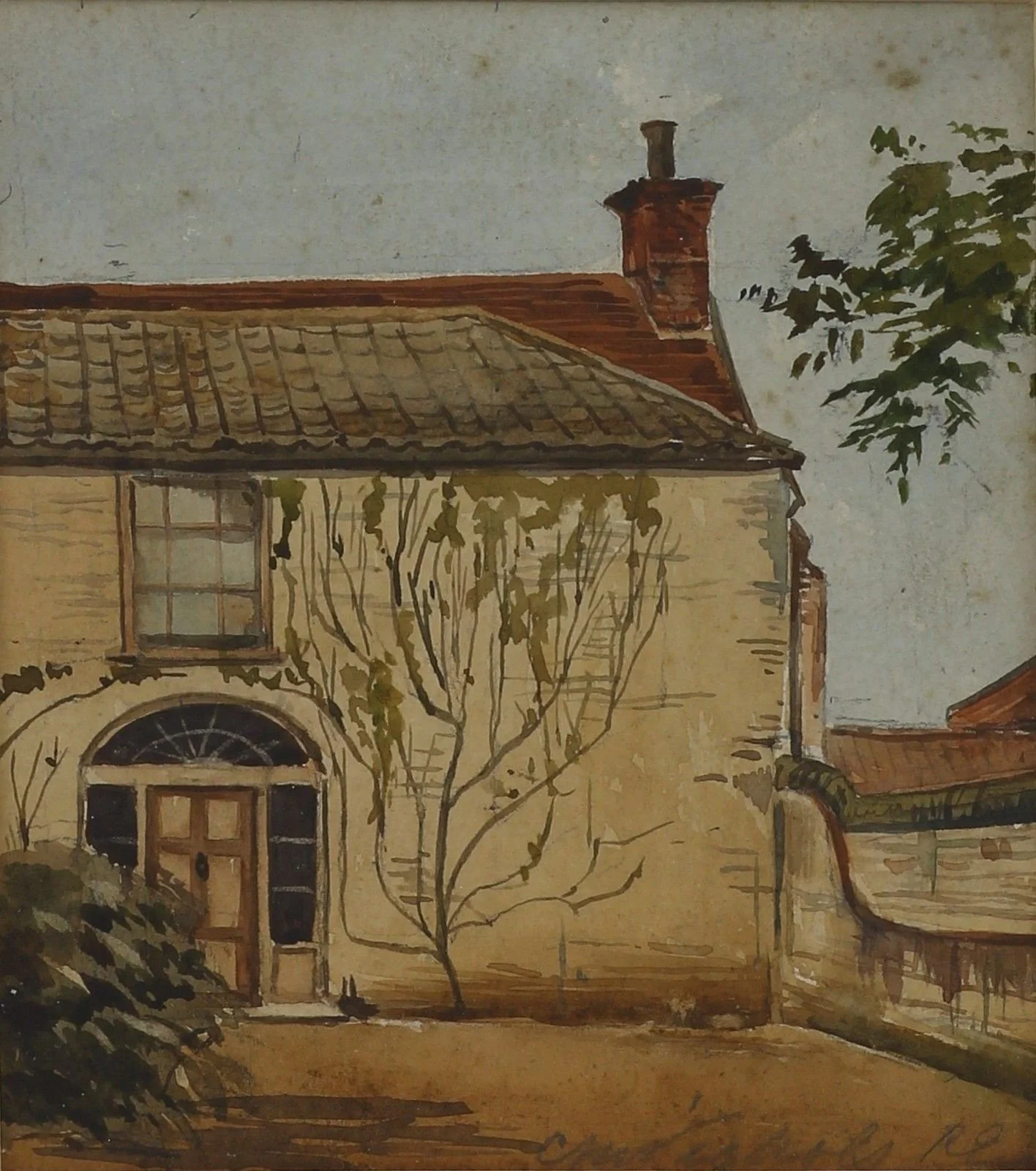
The Role of Art in Storytelling
Catherine Maude Nichols and the artistic tradition behind Days of Dandelion
There are cities that provide a setting for a story, and there are cities that seem to write stories of their own.
Norwich is one of the latter.
Long before Catherine Maude Nichols was walking its streets, studying its landscapes and exhibiting her work, Norwich had developed an unusually powerful artistic identity. In the early nineteenth century, the city became home to what is now known as the Norwich School of Painters: a remarkable community of artists who took the landscape immediately around them as a serious subject for painting.
At its heart were artists such as John Crome, John Sell Cotman, Joseph Stannard, George Vincent and Robert Ladbrooke. Crome and Ladbrooke founded the Norwich Society of Artists in 1803, creating what has been described as the first provincial art society in Britain to establish itself along lines comparable with the Royal Academy in London. Its first annual exhibition followed in 1805.
This was significant.
Art in Britain was still heavily centred upon London. Yet Norwich developed its own artistic community, its own exhibitions, its own networks of teachers and pupils, and perhaps most importantly its own artistic vocabulary.
The landscape of Norfolk became its subject.
The broad skies. The waterways. The fields. The trees. The marshes. The changing light.
John Crome, who spent his life in Norwich, repeatedly returned to the Norfolk landscape. Rather than seeking only the grand or picturesque, he could find subjects in ordinary places: fences, gravel pits, trees and stretches of open country. His landscapes gave the seemingly familiar an extraordinary quietness and dignity.
And that tradition matters enormously to Days of Dandelion.
Because the landscape in the novel is not merely scenery.
It is memory.
A city that taught itself to look
The Norwich School developed partly because Norwich was sufficiently distant from London to encourage its artists to form their own networks and learn from one another.
The result was unusual: a provincial artistic community that was not simply attempting to imitate London.
Artists met, exhibited, sketched together and taught one another. The society brought professional and amateur artists together, while the wider network of families, pupils, patrons and collectors helped create an environment in which painting could flourish.
The influence of the Norfolk landscape was inseparable from this.
But the Norwich artists were not isolated from the wider European tradition. Crome, for example, was influenced by Dutch seventeenth-century landscape painting as well as by the work of Richard Wilson, while the city's merchants and collectors brought continental paintings into Norfolk houses.
Norwich therefore occupied an interesting position.
It was local, but outward-looking.
Its artists painted Norfolk, but their artistic conversation extended far beyond Norfolk.
That tension between home and elsewhere is one of the things that fascinated me when developing Days of Dandelion.
Catherine Maude Nichols
More than half a century after the Norwich Society of Artists was established, Catherine Maude Nichols was born in Norwich in 1847.
She entered a city with an artistic inheritance already embedded in its cultural life.
Her father, W. P. Nichols, was a prominent Norwich surgeon and former Mayor of the city, as well as a collector of paintings. He encouraged Catherine's artistic interests and supported her education. She studied at the Norwich School of Art, where she won a prize for wood engraving in 1874.
But Catherine's ambitions took her beyond Norwich.
She travelled to France and worked around the Barbizon School, south of Paris, between 1876 and 1878. She subsequently worked in Cornwall and became associated with the artistic world from which the Newlyn group would emerge. She also painted around Norfolk and returned repeatedly to the landscape and urban environment of her home city.
That movement between places is important.
Nichols was not simply a Norwich artist painting Norwich.
She was a Norwich artist participating in a much wider European and British artistic conversation.
And she brought that experience home.
From Norwich to the Royal Academy
Nichols first exhibited at the Royal Academy in 1877 and continued to exhibit there for decades; sources record her Royal Academy exhibitions from 1877 through to 1909.
Her work extended across painting, watercolour, engraving and etching. She ultimately produced more than 200 etchings, many of them concerned with Norfolk and its landscapes.
But perhaps her most remarkable achievement came in 1882.
The Society of Painter-Etchers had been established in 1880. Nichols submitted her diploma work, Scotch Firs, and was elected a Fellow in 1882. The first woman to hold that distinction. The society later became the Royal Society of Painter-Etchers.
This is one of the reasons Catherine Nichols deserves to be remembered.
She was not simply a woman who happened to paint in nineteenth-century Norwich.
She had entered the professional artistic world at a time when that world was overwhelmingly male, exhibited at Britain's most important artistic institution, travelled to European centres of painting, and achieved a distinction within the emerging printmaking establishment that no woman had achieved before her.
Her reputation extended beyond Norwich. A contemporary biographical account records that her works were exhibited at the Royal Academy on numerous occasions and that she received an official communication from Munich thanking her for exhibiting there. It also records her membership of artistic societies in Norwich and London and her exhibitions in the capital.
In other words, Catherine Nichols was part of the artistic conversation of her time.
The woman behind the landscape
What interests me most about Nichols, however, is not simply the list of institutions to which she belonged.
It is the relationship between the artist and the places she continued to return to.
Norwich remained important to her.
She drew and painted the countryside around the city and the urban landscape itself. She became a co-founder and president of the Woodpecker Sketch Club, retaining that position until her death. She was also influenced by the earlier Norwich School; in 1907 she produced a portfolio of prints entitled After Crome.
That title alone says something extraordinary.
By then, the Norwich School belonged to an earlier generation. Yet Nichols was still looking backwards towards Crome while simultaneously participating in the contemporary artistic world.
She stood between traditions.
Between Norwich and London.
Between Britain and continental Europe.
Between painting and printmaking.
Between the nineteenth-century landscape tradition and the changing artistic world that followed it.
That is precisely the kind of historical figure who can become fascinating in fiction.
Why Catherine Maude Nichols belongs in Days of Dandelion
Days of Dandelion is concerned with what survives.
Paintings survive.
Buildings survive.
Landscapes survive.
But people do not necessarily remain attached to the things they created.
A name can disappear from public memory even when the work remains.
For me, Catherine Maude Nichols became a way of exploring that idea.
Her story begins in Norwich, but it does not remain there. Her artistic life reaches towards Paris, Cornwall, London and the wider European art world, before returning repeatedly to the landscapes that had shaped her.
That movement felt strangely appropriate for a novel about inheritance.
Because inheritance is not always something we consciously choose.
Sometimes it is a landscape.
Sometimes it is a painting.
Sometimes it is a name.
And sometimes it is a story that has been waiting for someone to look at it again.
Norwich as part of the novel
The Norwich of Days of Dandelion therefore exists on several levels.
There is the physical city: its streets, buildings, waterways and surrounding countryside.
There is the historical city: the place that produced an extraordinary provincial artistic movement and gave artists such as Crome and Cotman a setting in which to develop their work.
And then there is the remembered city, the Norwich that exists in paintings, photographs, family memories and stories.
That final Norwich is perhaps the most important.
Because a landscape is never simply what we see.
It is what we remember seeing.
And when an artist paints it, something of that memory becomes permanent.
That is why Catherine Maude Nichols matters to Days of Dandelion.
And that is why Norwich matters to the book.
The city is not simply where the story happens.
It is part of the story.
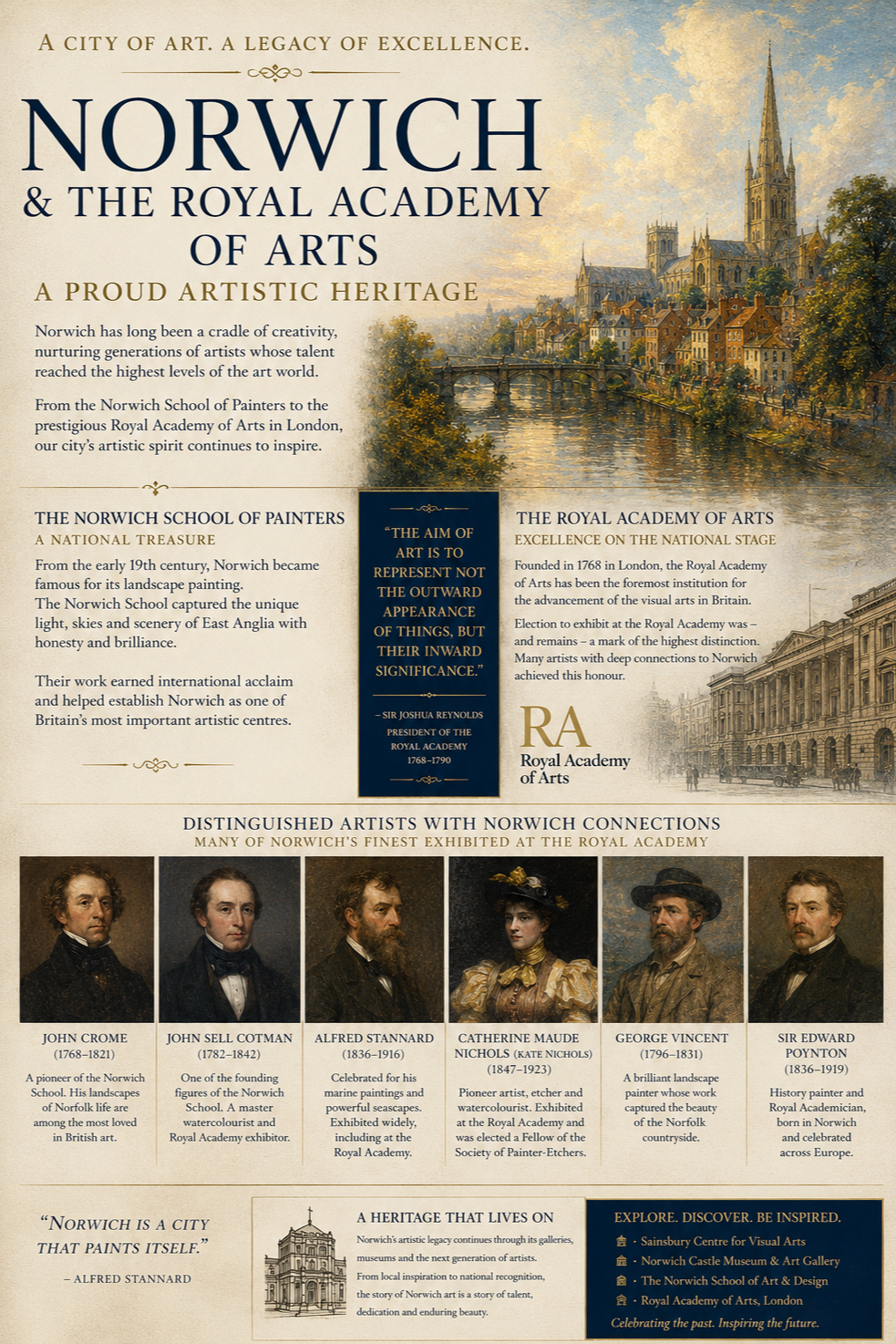
Norwich: The City of Stories, Art, and Landscape